

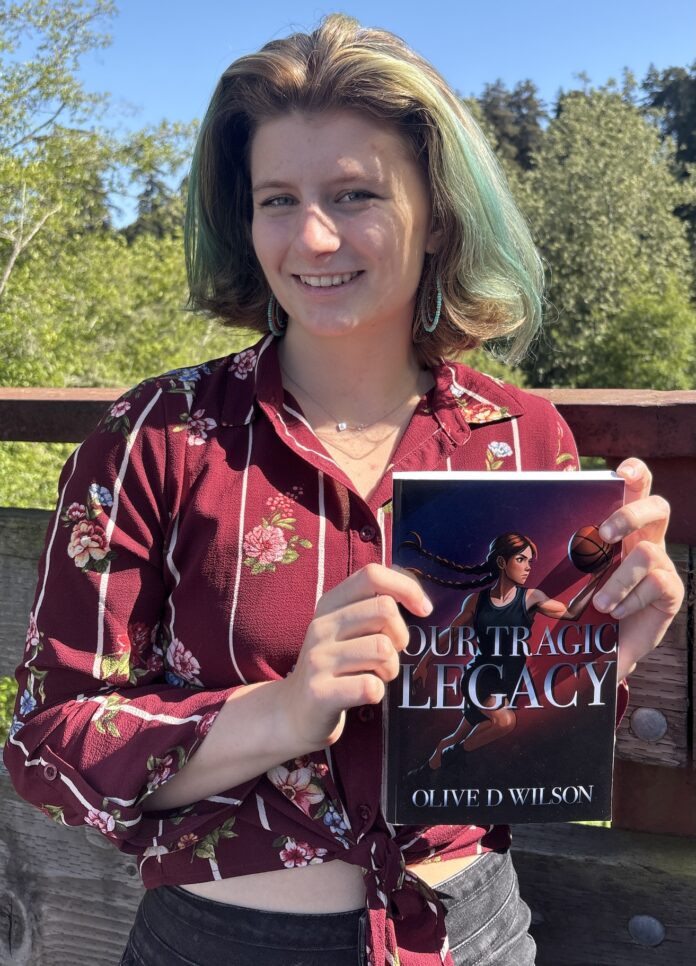
Olive D. Wilson discovered her love for writing early in life, chronicling her thoughts, experiences and ideas the way many writers do. Over time, that practice evolved.
What emerged from that reflective work, she realized, was both a story that needed to be told and the first step toward her life’s calling.
“All of a sudden, I had a 400-page manuscript,” she said.
That manuscript became the seed for her first novel, which she self-published at 15. It was the first in a three-book series — the “Misfits of Morality Trilogy” — about four teens who band together to overcome the pressures placed on them.
The books are available at Bookshop Santa Cruz and through online retailers such as Walmart, Amazon and Barnes & Noble.
Her fourth book, “Our Tragic Legacy,” will be released July 10.
The novel examines the pressures teen athletes face from coaches, parents and peers — a “shake it off” culture so embedded in sports that it is accepted even when it becomes abusive, she said.
“With coaches, it would be reasonable and rather normal, I found, for them to make you run until you throw up or something like that,” she said. “If a teacher did that or anything comparable, they would be fired.”
Wilson said she temporarily quit playing basketball to research and write the book, which centers on the children of intense sports parents.
“It’s about these children who maybe originally loved the game but are forced into it by parents and coaches and pressured to become good,” she said. “And it’s about their lives.”
Her research included interviews with Erin Wilson, an Olympic athlete and founder of Canada-based AthletesCAN; Indra Eliasson, a Swedish sports professor who specializes in coach abuse; and physician Charles Yesalis, an expert in performance-enhancing drugs.
“I had questions after quitting, like why are coaches and parents allowed to do so many more things than, say, teachers are allowed to do in the context of sport,” Wilson said.
She pointed to a study by AthletesCAN that found 60% of athletes experienced psychological abuse, 24% suffered an eating disorder and 18% engaged in self-harm.
“That led me down a rabbit hole of research where I was trying to find out why abuse is more prevalent in sports,” she said. “My job as a writer is to turn those statistics into emotion.”
Wilson hopes to help readers see beyond the idealized facade of sports into a largely unseen world where pressure from coaches, parents and peers can harm athletes.
Many athletes also fail to report such behavior because they fear repercussions from coaches or a loss of playing time, she said.
“My goal is to get people to actually care about this issue,” she said. “Because right now, as an athlete, it seems like they don’t. I think it’s that they don’t really understand how prevalent it is, and they also don’t understand how it affects athletes.”
That lack of awareness can extend to teen athletes themselves, who may not recognize abuse.
“They think that’s what love looks like,” she said.
After graduating from high school, Wilson hopes to attend Columbia University and land an internship with The New York Times as she pursues a career in writing.
“I always wanted to write with a purpose — to uncover something — like a modern-day muckraker,” she said. “I want to bring my books to a larger audience and gain the resources to learn more about communities that don’t have a voice, so I can help give them one through my writing.”